




Get special discount for all 2024 bookings.
Taste2wildlife is the fruit of more than 20 years work in tourism industry. Our team is composed of travel lovers and wildlife passionate.
We ensure the safety and security of our guests during their holiday
More than an island, Madagascar has been isolated for millions of years, which created a natural world found nowhere else. Madagascar’s wildlife, landscapes, and ecosystems make it one of the most distinctive travel destinations on Earth.
The majority of Madagascar tours depart from Antananarivo, commonly called Tana. You can take the East, West, North or South route according to your choice. The east is lush with primarily rainforests, waterfalls, and misty mountains. The West is mainly known for its vast plains, winding rivers, dry forests, and baobabs—the South features semi-desert landscapes, spiny forests, and unique rock formations.
In the brief below, we are going to outline what you can experience on the tours of your choice.
The Eastern tour departs from Tana to Andasibe and ends at Sainte Marie.
Andasibe is the most visited park in Madagascar and includes Analamazaotra Special Reserve and Mantadia National Park. The latter is a paradise for nature lovers. Its dense, primary rainforest is home to a remarkable array of endemic species, including the elusive black-and-white ruffed lemur, the red-bellied lemur, and the charismatic Diademed sifaka, often considered one of the most beautiful primates on Earth, with its golden-orange fur and silver crown. The park is also home to more than 100 bird species, many of them endemic, such as the pitta-like ground roller and the nuthatch vanga. The flora is just amazing, with ancient tree ferns, orchids, pandanus trees, and medicinal plants lining the trails, which can be rugged and steep. Together, Analamazaotra and Mantadia form a sanctuary of biodiversity found nowhere else on the planet.
The eastern rainforest is also home to the Indri lemur.
You cannot see baobab on this tour
At the end of the tour, we bring you to relax on the beaches of Sainte Marie.
Sainte-Marie combines palm-lined beaches with authentic charm. Sainte Marie is mainly known for its whale festival, which occurs from July to September, and we can see humpback whales surface to breathe or communicate with each other.
The tour departs from Antananarivo and ends at Morondava
This tour combines the famous Tsingy of Bemaraha and the beautiful Baobabs alley. The Tsingy is a must-see because it is one of the island’s most spectacular natural landmarks and is an elected UNESCO heritage site.
The Tsingy form an immense stone maze, crisscrossed by narrow passages, suspended walkways, and aerial viewpoints. These allow visitors to explore this terrain safely, with panoramic views of the Manambolo River and the surrounding plains. The park is rich in fauna and flora: many species of lemurs, endemic birds, reptiles, and rare plants such as Pachypodium rosulatum.
On the way back from the tsingy, you will discover the legendary Baobabs Alley. Baobabs are one of the main symbols of Madagascar after lemurs. They are referred to as the “Trees of Life” because they can live for over a thousand years, storing water in their massive trunks and providing shelter, food, and spiritual meaning to local communities.
On this tour, you can visit the Grandidier’s Baobab (Adansonia grandidieri), which is the tallest one in the world and forms the legendary Avenue of the Baobabs near Morondava, thereby attracting many tourists, especially at sunrise and sunset.
Visitors come across some lemurs at the Tsingy, as well as during the river decent.
It departs from Antananarivo to Diégo Suarez and ends at Nosy Be
This tour will lead you to the Tsingy of Ankarana. The Ankarana Special Reserve covers 18,220 hectares and is a place for the Tsingy. Here, the Tsingy is a massif and is razor-sharp with vast cave networks, underground rivers, and deep gorges. This unique ecosystem covers a remarkable biodiversity, including several species of lemurs, bats, reptiles, and endemic birds. Walkways, suspension bridges, and viewpoints allow visitors to explore the stone forest while enjoying panoramic views over canyons and dry forests.
On the way, you will discover the Red Tsingy: sedimentary formations arranged in layers, their colors varying from white to red. Formed by the erosion of red sandstone rather than limestone, these structures create a natural sandcastle, attracting visitors from all over the world.
Included in this tour is Ankarana National Park, where you can see Andansonia perriera, which is the rarest baobab species in the world.
We bring visitors to relax at Nosy Be beaches.
The Southern tour departs from Tana to Tuléar and allows visitors to explore two big National Parks: Ranomafana and Isalo.
Ranomafana National Park is famous for its diversity of lemurs, with over 12 species recorded. Some of the most iconic lemurs include:
Golden bamboo (Hapalemur aureus) is one of the park’s star species, critically endangered and endemic to this region.
Greater bamboo (Prolemur simus) is extremely rare and critically endangered.
Milne-Edwards’s sifaka (Propithecus edwardsi) is a large black-and-white lemur, often seen leaping between trees.
Red-bellied (Eulemur rubriventer) is diurnal and often found in pairs.
Isalo National Park is one of the country’s Must-Visit for Adventurers and Nature Lovers.
Home to at least 14 species of lemurs, including:
Ring-tailed (Lemur catta) is often seen in groups near rivers and campsites.
Verreaux’s sifaka (Propithecus verreauxi) is known for its elegant, dancing movement on the ground.
Red-fronted brown (Eulemur rufifrons) is active during the day, often spotted in the forested areas.
The park is also rich in reptiles, including Madagascar ground boas, chameleons, geckos, and skinks.
Over 80 bird species have been recorded, including Benson’s rock-thrush, Madagascar kestrel, and the Madagascar hoopoe.
A variety of colourful butterflies, beetles, and endemic invertebrates thrive in this ecosystem.
Visitors participating in this tour can see a baobab in Ifaty at the Renala Reserve.
Beach
At the end of the tour, we bring you to relax on the beaches of Ifaty or Ambatomilo.
Makay massif tour departs from Antananarivo to the South
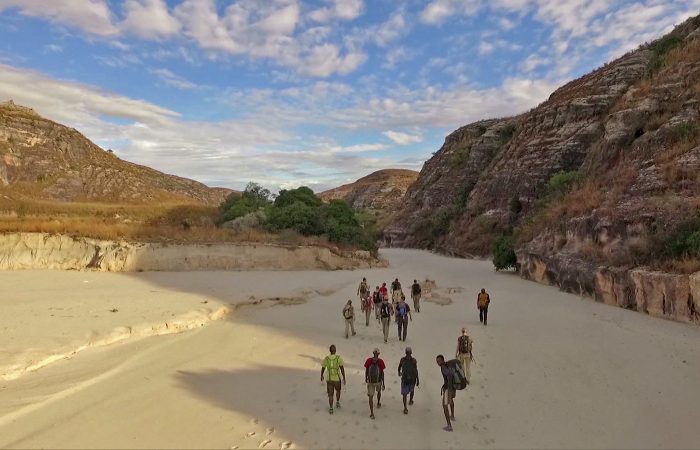
The Makay Massif, found in South-Central Madagascar, could be classified as a still unexplored region, often described as Madagascar’s last great wilderness. Accessible only on foot, it is composed of a large block of stone, sometimes reaching up to 1,000 m in altitude (Dafimavo) and at 977 m (Vohibe-Makay).
The Makay massif mainly consists of sandstone, making it one of the most incredible landscapes, consisting of beautiful gorges where rivers and waterfalls flow year-round. These isolated ecosystems have high biodiversity, including endemic plants, lemurs, reptiles, amphibians, and rare bird species.
The Makay offers a unique expedition experience, far from roads, villages, and mass tourism. Many days trek are needed to explore Makay, camping in pristine nature, crossing rivers, exploring narrow canyons, and discovering untouched landscapes that few travellers will ever see.
If you have come to Madagascar for this trek and still want to have some time on the beaches, we advise resting on beaches such as Ifaty, Ambatomilo, Sainte Marie, Nosy Be or Anjajavy according to your choice.
Our group tours comprise around 18 individuals, but we also have smaller group tours with 8 to 12 people. However, all the itineraries and facilities in the tours remain the same for both groups. These group tours are popularly called GIR (Groupe d’Individuels Regroupés), which is a French name. Our GIR program is below.
Day 1 – Arrival
Arrival at the airport of Antananarivo. Meet and be assisted by your tour guide—welcome and briefing. Transfer to the hotel.
Overnight at SAN CRISTOBAL.
Day 2 – Antananarivo / Andasibe
Breakfast at the hotel. Briefing and drive to Andasibe. Stopover at Peyrieras Reserve, known as Madagascar Exotic, a small but rewarding wildlife sanctuary where you can observe chameleons, frogs, butterflies, geckos, and other exotic critters up close, a perfect introduction to Madagascar’s unique biodiversity.
By the afternoon, we bring you to visit Vakona Private Reserve, of which the main attraction is Lemur Island, a sanctuary for rescued and habituated lemurs that have been relocated from captivity or areas of deforestation. Accessible by a short canoe ride, this small islet allows visitors to interact closely with several species of friendly, free-roaming lemurs, including common brown lemur, black-and-white ruffed lemur, bamboo lemur and red-fronted brown lemur.
Overnight at VAKONA FOREST LODGE.
Day 3: ANDASIBE
Breakfast at the hotel. Full-day guided visit to Analamazaotra Special Reserve, which is home to many species of lemurs and more than 100 bird species, many of them endemic, such as the pitta-like ground roller and the nuthatch vanga. The flora is just amazing, with ancient tree ferns, orchids, pandanus trees, and medicinal plants lining the trails, which can be rugged and steep.
Overnight at the hotel.
Day 4: ANDASIBE / ANTSIRABE
Early breakfast at the hotel. Road to Antsirabe, an elegant Spa Town with beautiful landscapes, rice fields, rolling hills, and traditional red-brick houses.
Overnight at ROYAL PALACE.
Day 5 : ANTSIRABE / MIANDRIVAZO
Breakfast. After a short city tour of Antsirabe, we head to Miandrivazo, a small town located on the banks of the Tsiribihina River. The landscape along the road marks the transition from the green highlands to semi-arid plains.
Overnight at PRINCESSE TSIRIBIHINA.
Day 6: MIANDRIVAZO / KIRINDY
Early breakfast. Drive to Kirindy, the road continues westward through landscapes dotted with baobabs, small farming communities, and vast savannahs. Kirindy is a wonderful place for wildlife. The park is best known for its nocturnal wildlife, including fossa.
Overnight at RELAIS DE KIRINDY.
Day 7: KIRINDY / BEKOPAKA
Breakfast. Drive to Bekopaka through a sandy track surrounded by baobabs, small villages, and open savannah. Bekopaka is the gateway to the « Tsingy de Bemaraha » National Park. The first major highlight is crossing the Tsiribihina River, where vehicles board a local ferry barge—a traditional river crossing that adds an authentic touch to the journey. A second river crossing—the Manambolo River—marks the final approach to Bekopaka.
Overnight at OLYMPE DE BEMARAHA.
Day 8: TSINGY OF BEMARAHA
Breakfast at the hotel. With a local guide, ascending the Manambolo Gorge by boat, and discovering magnificent caves on the way back. Exploring the “Petits Tsingy” from two viewpoints over the impressive pinnacles. Best for sunset view here.
Overnight at OLYMPE DE BEMARAHA.
Day 9: TSINGY OF BEMARAHA
Day 9 is a full-day visit to Grand Tsingy. The trip to the park takes half a day, and you can visit the whole park for the rest of the time. It is basically a forest full of rock formations called limestone, and we take you through many hanging bridges below your feet.
Overnight at the OLYMPE DE BEMARAHA.
Day 10: BEKOPAKA / MORONDAVA
Breakfast at the hotel. Drive back to Morondava, take a detour to the Baobabs in love. Stop by sunset at the famous Baobab Avenue to experience memorable photo-ops.
Overnight at VEZO BEACH.
Day 11 & 12: MORONDAVA
Two days free for leisure by the seaside.
Day 13: MORONDAVA/ ANTANANARIVO (by plane)
Breakfast at the hotel. Transfer to the airport—flight back to Antananarivo as per the flight schedule.
Meet and assist upon arrival. Transfer to the hotel
Overnight at SAN CRISTOBAL.
Day 14: DEPART ANTANANARIVO
Breakfast at the hotel. According to the flight schedule, a car is at your disposal for the city tour. Transfer to the airport, assistance with check-out.