


Lemurs are endemic to Madagascar. Over 110 species and subspecies of lemurs have been identified. There is the smallest one, mouse lemurs, which are below sixty grams, and the athletically impressive Indri, which can leap over a distance of ten meters, living for the most part in a thick rainforest canopy. These animals live in different ecosystems, like dense rainforests to dry and spiny deserts south and west of the island. Madagascar’s network of national parks, managed by Madagascar National Parks (known as ANGAP), plays a vital role in protecting these primates and their natural habitats.
This guide provides an overview of the lemur species found in almost all regions and national parks across Madagascar. These destinations include both popular and lesser-known remote reserves. Whether you plan to take photographs, hike, or do academic fieldwork, the summary below will help you choose the right destination based on your interest in these remarkable animals.

We propose 03 packages for you to explore the Eastern lemur species in the National Parks
You will visit Analamazaotra Special Reserve and Mantadia National Park for lemurs, will discover the Pangalane channel by boat and the beautiful island of Sainte Marie
This is a combination of the Southern Part of the island and the Eastern Part, where you are going to visit three National Parks namely Isalo, Ranomafana and Mantadia National Parks together with and Analamazaotra Special Reserve. You will also discover the Pangalane channel by boat.
This tour includes five lemur national parks namely Ranomafana, Isalo, Zombitse, Ankarafantsika and Mantadia. It is especially designed for nature lovers, birdwatchers, scientists or researchers. Then we take you to relax on the beautiful beach of Ifaty. After that, there is a visit to Renala Reserve to discover one of the most enormous baobabs of the island.

We propose six packages to explore the Southern part of the island.
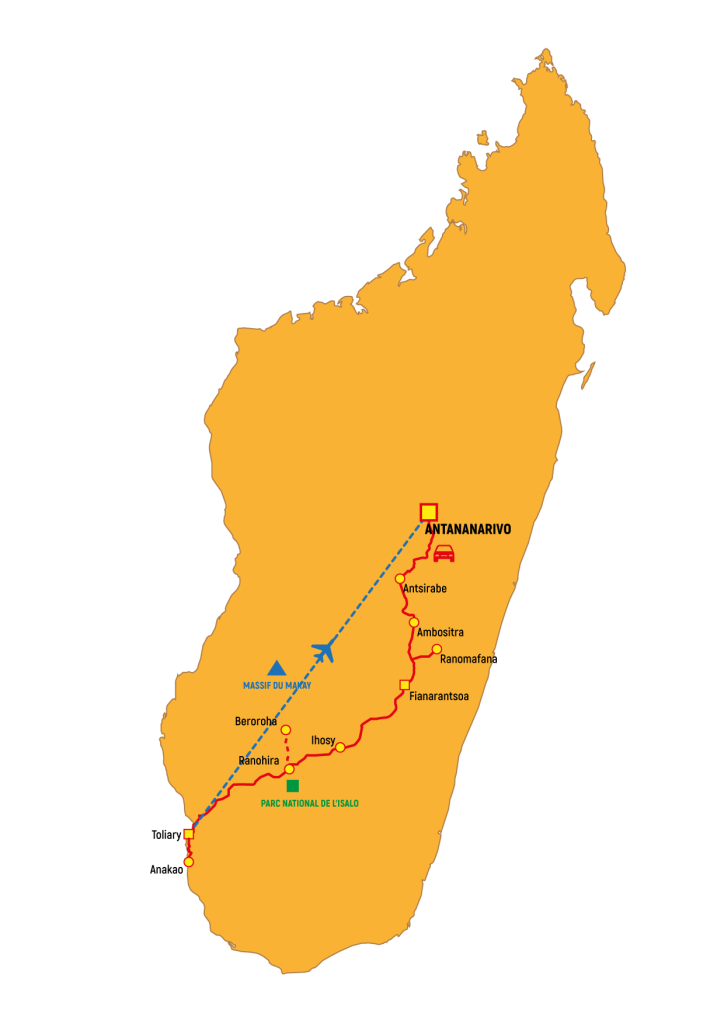
You will discover two central National Parks on the Southern Road in the itinerary: Ranomafana and Isalo, beautiful landscapes, colourful tombs rich with history and baobabs all along the road. You also visit Renala Reserve with its giant baobab tree before heading to the beautiful sea resort in Ifaty.
This is a combination of the Southern Part of the island and the Eastern Part, where you are going to visit 03 National Parks: Isalo National Park and Ranomafana National Park in the South, then Analamazaotra Special Reserve and Mantadia National Park in the East. You will discover the Pangalane channel by boat.
You will discover two central National Parks on the Southern Road in the itinerary: Ranomafana and Isalo, beautiful landscapes, colourful tombs rich with history and baobabs all along the road. Visit of Renala reserve with its giant baobab tree before going to the beautiful sea resort of Ifaty. This tour aims to support local communities through donations to an association that cares for children of incarcerated parents in Antsirabe, and by staying at a solidarity-based hotel in Ifaty.
In this tour, you can explore three lemur national park namely Ranomafana, Andringitra and Isalo . The tour also includes hiking and camping on the Pic Boby and exploration of Zafimaniry village which was inscribed on the UNESCO World Heritage list in 2008.
We offer Makay Massif as an expedition and here you can see the red-fronted lemurs, the elusive bamboo lemurs (Hapalemur) and the most iconic Verreaux’s sifaka, a very rare lemur variety. Hundreds of canyons and labyrinths, special vegetation, very rich and unique vegetation and wonderful scenery awaits discovery during Makay expedition.
Include five lemur national parks namely Ranomafana, Isalo, Zombitse, Ankarafantsika, Mantadia before relaxing at the beautiful beach of Ifaty. Then we make you visit Renala Reserve to discover the enormous baobabs. A tour especially designed for nature lovers, birdwatchers, scientists or researchers.

We officially propose only one package to explore the Western Part.
We explore the Bemaraha National Park, another UNESCO heritage for lemurs and the amazing limestones, the Manambolo river gorge and the Baobabs Avenue. We can add any of Sahamalaza
Namoroka and Baie de Balyon national parks demand.

Here also we offer one package that includes two lemurs national parks.
You get to explore the region of Diégo and its two central National Park namely Montagne d’Ambre and Ankarana National Park. You will also visit the Vanilla and cocoa plantation. After that we transfer you by boat to visit Nosy Be island with its beautiful beaches.
Form part of our packages or may be added to our packages if not listed in the above tours.
Home to several species of lemurs, Andasibe-Mantadia is located about 140 km East of Antananarivo. It consists of two main sections: Analamazaotra Special Reserve and Mantadia National Park.
Lemur species:
Best for:
Wildlife photographers, birders, nature lovers, and families. This park is ideal for first-time visitors to Madagascar who want to see iconic species like the Indri.
2. Mananara-Nord National Park
Five lemur species form part of Mananara-Nord National Park. It is on Madagascar’s northeast coast. This park, which gets tiny visits, includes both mainland forest and marine protected areas, including the island of Nosy Antafana.
Lemur species:
Best for:
Eco-conscious travelers, scientists, and marine/forest biodiversity enthusiasts. The park offers a rare combination of marine and terrestrial ecosystems, and remains one of the least disturbed coastal forests in the country.
Nosy Manga Be is a small island reserve off the coast of Masoala National Park, known for its pristine forest and significant lemur populations.
Lemur species:
Best for:
Ecotourists and primatologists are seeking rare species in a protected island environment. Access is by boat and often combined with Masoala visits.
With seven species of lemurs, this remote and dense park lies east of Lake Alaotra and is part of the UNESCO-listed rainforests of the Atsinanana.
Lemur species:
Best for:
Hardcore nature lovers and researchers. Access is often only by foot from nearby villages. The park is a refuge for some of the island’s most endangered primates.
Six lemur species inhabit the Masoala National Park, which is the largest national park in the country. It forms part of the UNESCO-listed Rainforests of the Atsinanana and is one of the most important conservation sites in the country.
Lemur species:
Best for: Hardcore nature lovers, wildlife photographers, and researchers. Masoala offers one of the wealthiest and least disturbed rainforest ecosystems in Madagascar. Though remote and logistically challenging, it rewards visitors with extraordinary biodiversity and a true sense of wilderness.
The nine lemur species in this southeastern part of Madagascar are UNESCO World Heritage-listed with lush rainforest, waterfalls, and hot springs.
Lemur species:
Best for:
Researchers and serious wildlife enthusiasts. Ranomafana is a hotspot for endemic species and scientific discovery. The trails are challenging but rewarding, and night walks are rich in nocturnal species.
Located south of Fianarantsoa, Andringitra is inhabited by seven species of lemur. It is home to Madagascar’s second-highest peak, Pic Boby (2,658m).
Lemur species:
Best for:
Experienced hikers, climbers, and researchers. The park’s rugged terrain and ecological gradients make it ideal for diverse lemur communities and highland biodiversity studies.
Isalo is famous for its dramatic landscapes and hosts four lemurs.
Lemur species:
Best for: Visitors who enjoy hiking and dramatic scenery. While not a biodiversity hotspot, the lemurs are relatively easy to observe, and the mix of landscape and fauna is unique.
Tsimanampetsotsa National Park has four species of lemurs. It has arid landscapes, including a large saline lake, unique vegetation, and endemic fauna adapted to drought.
Lemur species:
Best for: Visitors interested in unique dry ecosystems and wildlife adapted to arid conditions. Night walks are highly recommended to see nocturnal species.
Spiny forest and riverine gallery forest. Situated near Fort Dauphin (Tolagnaro), Berenty is a small but legendary private reserve, especially famous for behavioural studies of lemurs.
Lemur species:
Best for: Those interested in close-up photography and guaranteed lemur sightings. Berenty is also a centre for academic research, particularly long-term primate studies. It is excellent for visitors with limited mobility.
With six lemur species, Andohahela is a rare example of a park that contains both rainforest and spiny forest, due to the Anosy mountain range acting as a climate barrier.
Lemur species:
Best for: Ecologists, botanists, and nature-loving visitors who want to understand ecological transition zones. Accessibility is moderate, and guides are essential for navigating different sectors.
It is a dry deciduous forest with lakes and savannah. Located in Northwestern Madagascar near Majunga, this park offers excellent wildlife watching, particularly for birds and lemurs.
Lemur species:
Best for: Birdwatchers and primate researchers. The dry forest offers excellent visibility. Night walks are especially rewarding.
Sahamalaza national Park is part of a UNESCO Biosphere Reserve known for its coastal biodiversity with four lemur species amongst others.
Best for: Conservationists and researchers interested in endangered species. The park is remote, and access requires local guides. Night walks offer chances to spot rare nocturnal lemurs.
Namoroka National Park has five lemur species, but is visited significantly little
Lemur species:
Best for: Adventurers and spelunkers interested in off-the-beaten-path experiences. It is not heavily touristed and is best explored with a guide and a local naturalist.
This park is home to several lemur species listed below. It is a dry deciduous forest, mangroves, swamps, savannah, and coastal lagoons. It is known mainly for being the only natural home of the Ploughshare tortoise (Astrochelys yniphora).
Lemur species:
Best for: Conservationists and researchers. The park is remote and difficult to access, but vital for protecting critically endangered species. Visits often require coordination with conservation NGOs.
This park is famous for its unique limestone karst formations known as “Tsingy,” and is found western Madagascar along the Tsiribihina River. It is UNESCO World Heritage Site and is famous for its dramatic limestone pinnacles, labyrinthine caves, and rare biodiversity. it has 6 lemur species.
Best for: Adventurers, wildlife photographers, and researchers who want to explore unique karst landscapes alongside rare and endemic lemur species. Trekking can be physically demanding but rewarding.
Located in Northern Madagascar, Montagne d’Ambre is one of the most accessible rainforest parks. It inhabits 6 species of lemur and was the first national park established in Madagascar in 1958.
Lemur species:
Best for: Families, photographers, and travelers looking for an accessible rainforest experience. Night walks are excellent, with high chances of seeing mouse lemurs, chameleons, and frogs.
Marojejy is one of the most pristine and remote parks in Madagascar and part of the UNESCO Rainforests of the Atsinanana. Lemur species found here are:
Best for: Hardcore hikers and researchers. The terrain is challenging, but the rewards include rare species and breathtaking scenery. The Silky Sifaka is a flagship species here.
Daraina Protected Area: Dry and humid transitional forest. Located in northeastern Madagascar between Vohemar and Daraina, the Loky-Manambato area (often just called “Daraina”) is a protected forest corridor known for one scarce lemur species.
Lemur species:
Cheirogaleus sp. (various dwarf lemurs under study)
Propithecus tattersalli (Golden-crowned sifaka) – one of the rarest lemurs, only found in this region
Eulemur albifrons (White-fronted brown lemur) – observed in mixed habitats
Microcebus sp. (likely undescribed mouse lemurs)
Antananarivo Airport